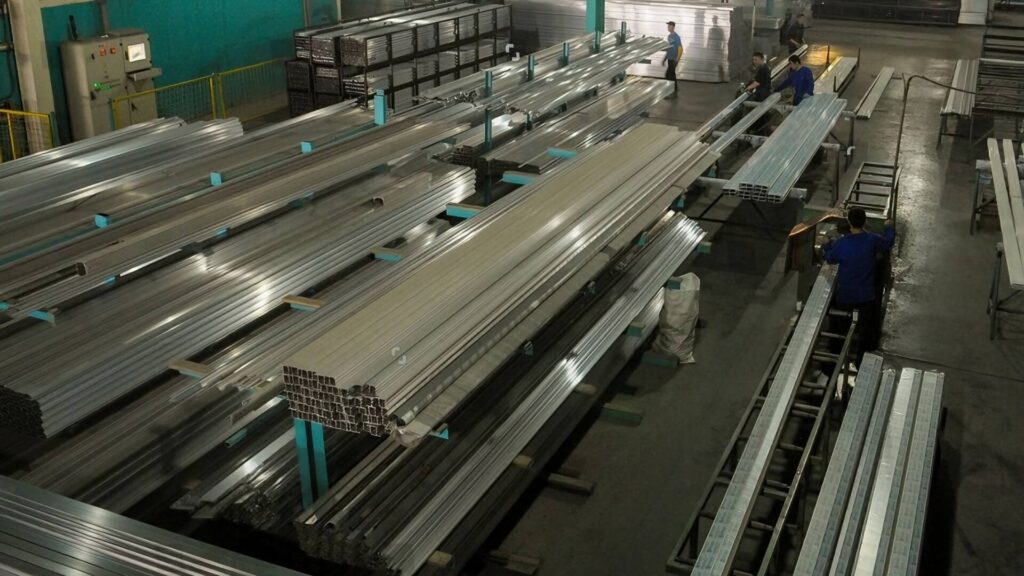

Sheet metal bending is a manufacturing process that applies heavy force to a flat piece of metal to alter its geometry without breaking it or removing material. Think of it like folding a stiff piece of cardboard to create an angle, a curve, or a box.
As the Production Lead here at ShincoFab, I’ve spent more than 10 years programming CNC press brakes and quoting over 10,000 custom fabrication jobs. I haven’t just read about this process. I have seen firsthand what works, what fails on the shop floor, and what design mistakes can unnecessarily inflate your manufacturing costs.
This guide shows you specifically how we choose the right bending method for our clients’ projects every day. You will learn which alloys to use, how to avoid paying for custom tooling, and how to prevent your material from cracking under the punch.
By the end of this post, you will know how to secure the precise parts you need while optimizing your overall production budget.
Let’s get straight to it.
Why Choose Sheet Metal Bending?
Bending metal properly solves major manufacturing headaches. The three primary benefits of choosing sheet metal bending over alternative fabrication methods are cost savings, stronger parts, and reduced welding.
- Cost savings: Bending a single sheet is significantly cheaper and faster than cutting multiple separate parts.
- Stronger parts: A solid, bent piece of metal is physically tougher than a joint held together by screws.
- Reduced welding: Welding requires time, increases costs, and creates structural weak points. Bending helps you bypass that messy process.
Here is my golden rule for you: Stop overpaying for precision you do not need.
Steer clear of unnecessary, highly accurate bending methods. Instead, you should default to a method called air bending for 80% of your projects.
Air bending utilizes standard tools to push the metal into shape. Consequently, it saves you from buying custom dies, drastically cuts down on setup time, and keeps your budget in check. You only need to pay for premium methods when your part demands flawless, exceptionally tight-tolerance angles.
What Are the Best Metals for Sheet Metal Bending?
Before you bend anything, you have to know your metal. Your material choice largely determines project success. Some metals fold smoothly, while others snap and drive up material waste.
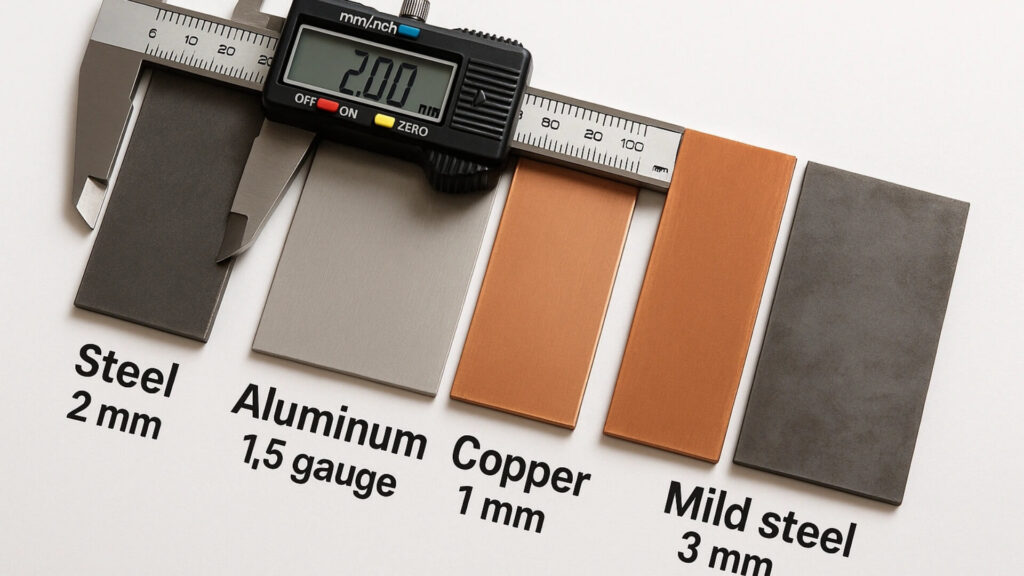
The most highly formable metals used for standard sheet metal bending projects are mild steel, aluminum, and copper.
- Mild Steel: This is the ultimate industry workhorse. It is cost-effective, highly flexible, and behaves highly consistently on the press brake.
- Aluminum: Lightweight and forgiving. It bends easily without cracking, making it perfect for custom parts and brackets.
- Copper: Soft and highly malleable. It requires very little effort to bend, making it widely used in electrical applications and plumbing systems.

However, you must plan carefully for tougher materials. The most common tough materials that require special heating or planning during sheet metal bending are stainless steel and titanium.
- Stainless Steel: It is exceptionally strong, but it fights back. On our shop floor, we intentionally over-bend 304 stainless by an extra 2 to 3 degrees to account for its aggressive springback toward its original flat geometry.
- Titanium: This metal is tough and light, but notoriously stubborn when bent cold. If a client asks us to bend a sharp angle in titanium alloy sheet at room temperature, we usually recommend hot forming instead, because alloy grades often require heating to about 800–1000°F (425–540°C) for successful for
What Are the Most Common Sheet Metal Bending Shapes?

Manufacturing jobs rely on foundational shapes to build complex components. The four most common sheet metal bending shapes used in manufacturing are the V-bend, U-bend, Z-bend, and hemming.
V-Bend
This is your bread and butter. A V-bend creates a classic V-shape, typically hitting a sharp 90-degree angle. You will utilize this constantly for basic brackets, simple frames, and corner joints.
U-Bend
A U-bend looks similar to a V-bend, but it features a smooth, rounded bottom. That curve distributes the stress evenly across the metal. Furthermore, this helps ensure your part does not crack under heavy mechanical pressure.
Z-Bend
Sometimes your part needs to step up and over another component. A Z-bend hits the sheet metal with two opposing angles to change directions. It is the ideal profile for creating custom mounting brackets or stepping down an overlapping joint.
Hemming
Hemming prevents injuries from sharp, raw metal edges. This process folds the edge of the sheet securely over onto itself. Ultimately, it hides the sharp edge for safety while adding massive structural stiffness to the panel.
How to Bend Sheet Metal (8 Common Methods)
There are several distinct methods to form sheet metal, ranging from standard die pressing to high-speed folding. Choosing the optimal method depends heavily on your required tolerances, production volume, and tooling budget. The eight most common methods used to bend sheet metal are air bending, bottom bending, coining, folding, wipe bending, roll bending, rotary bending, and joggle bending.
Air Bending
Air bending is a flexible forming method where the press brake punch pushes the sheet metal into a V-shaped die without touching the bottom. This is your 80% solution. It gives you the flexibility to create multiple angles using the same tools. Today, modern CNC press brakes easily hit tight tolerances of +/- 0.5 degrees using standard dies.
Bottom Bending
Bottom bending is a high-accuracy forming method where the punch forces the sheet metal deeply into the die until it hits the bottom. If your project requires more accuracy than air bending, this is your logical next step. It reliably delivers the specific angle you want without paying the high costs of custom tooling.
Coining
Coining is a precision stamping process that uses extreme tonnage to permanently press sheet metal into a die. Because the metal is placed under such high pressure that it plastically flows, the process virtually eliminates springback and consistently hits ultra-tight tolerances. But be warned: it requires massive force—often 5 to 8 times more than standard air bending—and expensive custom tools. Only use coining when the highest precision is strictly required.
Folding
Folding is a bending process where a machine clamps the metal flat while a swinging beam folds the protruding edge upward. Folding is ideal for large, thin sheets that are hard to handle. Additionally, the tool does not drag across the metal, meaning it is much less likely to scratch your surface finish.
Wipe Bending
Wipe bending is a high-speed forming method that holds the sheet tight while a punch slides down the edge to bend it over. Because it requires very little force and operates rapidly, wipe bending saves massive amounts of time for large-scale mass production runs.
Roll Bending
Roll bending is a continuous forming process that passes sheet metal through a set of heavy rollers to create smooth, rounded curves. It is the standard manufacturing process for fabricating pipes, cones, and architectural pieces.
Rotary Bending
Rotary bending is a mar-free forming method that uses a spinning cylinder to roll the metal into a bend. It does not drag or scrape against the material. If your metal is already painted or polished, rotary bending protects it, leaving virtually no surface damage.
Joggle Bending
Joggle bending is an offset forming process that creates a tiny step-down in the metal. This allows the next sheet to sit flush on top. It is the preferred method for building smooth panels and tight enclosures without creating a prominent overlapping bump.
How Do You Calculate Bend Radius, K-Factor, and Bend Allowance?
Before sending your part to the press brake, designers must account for how metal stretches. When metal bends, the outside edge stretches while the inside edge compresses. As a CNC programmer, I rely on specific rules and mathematical formulas to cut the initial flat pattern to the appropriate size. The critical mathematical formulas used to calculate sheet metal bending flat patterns are minimum bend radius, K-factor, bend allowance, and bend deduction.
- Minimum Bend Radius: This is the inside curve of your bend. As a general rule, do not design a bend radius smaller than your material’s thickness (known as 1T). For mild steel, a 1T radius works well. Meanwhile, for stiffer metals like 304 stainless or 6061 aluminum, you must increase this to a 2T or 3T radius to prevent cracking.
- K-Factor: This multiplier defines the location of the neutral axis where the material neither stretches nor compresses. K-Factor usually falls between 0.3 and 0.5. It is calculated by dividing the neutral axis offset (t) by the material thickness (T). In practice, we bend a sample scrap piece, measure the final bent dimensions, and reverse-engineer the accurate K-Factor for that specific batch of metal.
- Bend Allowance: This calculates the physical length of the curved section (the arc) of your bend using your established K-Factor and bend radius.
- Bend Deduction: This is the specific amount of material you must subtract from your flat pattern’s total length to accommodate the metal’s stretching behavior.
Calculating these precise design entities in your initial CAD software helps ensure your final folded part hits the target dimensions you need.
How Do Tolerances Affect Tooling Costs?
Every time you demand a tighter tolerance, your tooling costs escalate.
You do not need to pay the premium for Coining to achieve a strict +/- 0.5-degree angle. A modern CNC press brake hits that precise mark using Bottoming, or even Air Bending. You only need Coining if you are stamping a highly specific design into the metal or building parts for aerospace applications. For everything else, it generally adds unneeded production costs.
Designing a non-standard bend increases tooling costs significantly. The two primary tooling options for sheet metal bending are standard V-dies for air bending and custom dies for coining.
- Standard V-Dies: These are off-the-shelf tools running between $50 and $200 per foot. Your manufacturer typically has them sitting on the shelf.
- Custom Dies: These must be machined from scratch for your specific shape. A custom set typically ranges between $1,000 and $5,000, depending on complexity.
If you do not strictly need a custom angle, stick to standard bends.
Which Bending Method is Best for Prototyping vs. Mass Production?
Your production volume changes the whole game. The most cost-effective method for a small batch is often highly inefficient for a massive run. The best sheet metal bending methods based on production volume are air bending for prototypes and wipe bending or coining for mass production.
- Prototyping: For a small 5-part prototype, you generally want Air Bending. It utilizes standard tools. You avoid custom tooling fees, and parts finish quickly.
- Mass Production: For a 50,000-part run, you want Wipe Bending or Coining. The custom dies cost thousands of dollars up front. However, when spread across 50,000 parts, the amortized tooling cost becomes negligible per piece. These methods operate incredibly fast, saving enormous labor costs.
The secret difference between these methods lies in the setup time. The typical press brake setup times on a factory floor are 15 minutes for air bending and 2 to 3 hours for coining.
- Air Bending Setup: Takes about 15 minutes. The operator drops in standard tools, programs the machine, and begins working.
- Coining Setup: Takes 2 to 3 hours. The operator must closely align the custom dies and test them multiple times before running the batch.
Can You Bend Sheet Metal at Home? (DIY vs. Pro Shops)
Startup founders and hobbyists can bend simple prototypes in a garage without stepping foot in a factory.
If you are working with thin aluminum or mild steel, you can pull off simple folds yourself. A cheap manual brake, or even a heavy bench vise and a rubber mallet, easily handles basic 90-degree V-bends. It is an excellent strategy to save money on your very first prototype.
But there is a hard limit to DIY bending.
You should hire a professional shop like ShincoFab when your metal gets thicker than a standard 14-gauge (about 0.075 inches for steel). You also need a pro if your design requires complex Z-bends, strict tolerances, or a production run of more than 50 parts. Garage tools simply cannot deliver repeatable tonnage and precision.
What Are the Most Common Sheet Metal Bending Mistakes?

Bending metal is not always a smooth process. The material frequently warps or snaps in half.
Blueprint accuracy determines who pays for scrapped metal. If you design an impossible bend and force the shop to try it anyway, you pay for the scrap. Conversely, if the factory ruins a well-engineered design, they eat the cost.
To protect your budget, you must understand the two biggest physical risks in sheet metal bending.
What is the Springback Effect in Sheet Metal?
Springback is the physical tendency of sheet metal to partially return to its original flat shape after bending pressure is released. Because metal has a memory, a sheet bent specifically to 90 degrees will often relax and bounce back to 92 or 93 degrees.
To fix it, the machine must intentionally over-bend the metal so it relaxes into the target angle. If you do not plan for this, it results in costly scrap and rework. Generic factories report up to a 15% scrap rate on thick materials simply because designers failed to account for springback. At ShincoFab, our machine operators and software simulate this bounce-back before we cut a blank, minimizing material waste and protecting your bottom line.
Why Does Sheet Metal Crack During Bending?
Sheet metal splinters just like wood when bent incorrectly.
Metal features a distinct grain direction, a microstructure resulting from the heavy rollers at the steel mill. Our machine operators at ShincoFab inspect this grain before ever stepping on the pedal. If you bend your part directly parallel to that grain, the metal is highly likely to split open. Therefore, you must design your bends to go across the grain.
You also need to monitor your bend radius. If you force a thick piece of metal into a sharp, tight corner, it fractures under the stress. It is best practice to give thicker metals a wider, softer curve.
Avoid these rookie mistakes, and you will avoid costly overruns caused by defective parts.
Conclusion
Sheet metal bending does not have to be a guessing game. By selecting the correct metal and sticking to cost-effective methods like air bending, you protect your capital.
Remember to account for springback and always bend across the material grain. Keep your designs simple unless your project explicitly demands custom tooling.
When you outgrow your garage prototype and need a reliable factory, we are here to help. At ShincoFab, we handle sheet metal fabrication every single day. We will help you review your design, select the best bending method, and keep your production costs firmly under control.
Got a drawing ready to go? Reach out to our team. Let’s get your parts made the right way.