Whether you are firing up a backyard forge, dialing in a welder, or just curious about how hot a fire needs to be to liquidize a car engine, you need to know the numbers.
But here is the tricky part: Steel doesn’t have just one melting point.
Because steel is a mix of different ingredients, asking for its melting point is like asking how long to bake a cake. It depends on the recipe.
If you get these numbers wrong, you might burn a hole through your welding project or even build a structure that collapses when it gets hot.
In this guide, I’m skipping the complex chemistry lectures. I will give you the exact temperature ranges for the most common types of steel, explain why they change, and show you how to judge the heat just by looking at the color.
💡 The Factory Perspective
As a manager at ShincoFab who deals with sheet metal daily, I don’t usually worry about turning steel into a liquid puddle unless we are in the welding bay. In our factory, knowing the melting point is not just trivia. It dictates how we set the power on our fiber laser cutters and how we control heat distortion during assembling.
If we misjudge the thermal properties of a specific grade, we don’t just get a bad weld; we ruin expensive customer parts. So, while I’ll explain the science, I’m also going to share how these numbers actually play out on the factory floor.
Let’s get straight to the numbers.
What is the Melting Point of Steel?
If you are in a rush and just need the numbers, here they are.
Generally, steel melts between 2,500°F and 2,800°F (1,370°C and 1,540°C).
To give you some context, that is hotter than volcanic lava. Lava usually flows around 2,200°F. Steel requires serious heat to turn into a liquid puddle.
Why There Is No Single Number
You might be wondering why that range is so wide. A 300-degree difference is huge.
The reason is simple: Steel is not a pure element.
If you melt pure Gold, it always melts at exactly 1,948°F. But steel is an alloy. Think of it like a pot of soup.
- The Broth: The main ingredient is Iron.
- The Spices: We add “ingredients” like Carbon, Chromium, Manganese, and Nickel.
Every time you change the recipe, you change the melting point.
Adding more carbon usually lowers the melting temperature. Adding chromium (like in stainless steel) changes it again.
So, to get an exact number, we need to look at the specific type of steel you are using. Let’s break down the most common ones.
Melting Points of Common Steel Types
Most people just say steel, but there are thousands of different recipes.
A structural beam in a skyscraper is very different from the knife in your kitchen. Because the ingredients change, the melting point changes too.
Carbon Steel
This is the most common type of steel. It is what we use for buildings, bridges, and car frames.
- Low Carbon (Mild) Steel: Think of this as the basic vanilla option. It has very little carbon, so it has a higher melting point (around 2,700°F).
- High Carbon Steel: This is harder and stronger. It is used for springs and high-strength wires. Surprisingly, adding more carbon actually lowers the melting point. High carbon steel melts closer to 2,600°F.
Stainless Steel
You know this one. It’s shiny and doesn’t rust.
To make steel stainless, manufacturers add Chromium. This acts like a shield against rust. Common grades like 304 and 316 stainless steel (used in kitchen sinks and marine gear) melt around 2,550°F to 2,650°F.
Tool and Alloy Steels
These are the elite operators of the steel world.
Tool steels contain tough elements like Tungsten, Cobalt, or Vanadium. They are designed to cut other metals. Because they are so hard, they often retain their strength at high temperatures better than basic carbon steel, even if their melting point is similar.
Cheat Sheet: Melting Points by Grade
Here is a quick reference table based on standard material property data to help you find the exact number you need.
| Steel Grade | Melting Point (°F) | Melting Point (°C) | Common Uses |
|---|---|---|---|
| 1018 (Low Carbon) | 2,590°F – 2,750°F | 1,420°C – 1,510°C | Brackets, mounting plates, structural beams |
| 1095 (High Carbon) | 2,460°F – 2,680°F | 1,350°C – 1,470°C | Knives, springs, cutting tools |
| 304 Stainless | 2,550°F – 2,650°F | 1,400°C – 1,455°C | Kitchen sinks, cookware, piping |
| 316 Stainless | 2,500°F – 2,550°F | 1,370°C – 1,400°C | Marine hardware, chemical tanks |
| D2 Tool Steel | 2,500°F – 2,600°F | 1,370°C – 1,425°C | Industrial cutters, drill bits |
| Cast Iron | 2,060°F – 2,200°F | 1,127°C – 1,204°C | Skillets, engine blocks, manhole covers |
Note: I included Cast Iron at the bottom for comparison. Notice how much lower its melting point is compared to steel!
Now that you have the numbers, you might be wondering why adding carbon makes the melting point drop. It seems backward, right? Let’s explain that next.
Why Does the Melting Point Change?
You might think that adding strong materials like carbon would make steel harder to melt. It actually does the opposite.
Here is the simple science behind it.
The Role of Carbon: The “Salt on Ice” Effect
Pure iron is stubborn. Its atoms are locked in a tight, perfect grid. It takes a massive amount of heat energy (2,800°F) to break that grid apart and turn it into liquid.
Carbon acts like salt on ice.
When you sprinkle salt on an icy sidewalk, the ice melts faster. The salt disrupts the water crystals.
Carbon does the same thing to iron.
- Low Carbon Steel: Has very little carbon. The iron atoms are tight. High melting point.
- High Carbon Steel: Has more carbon. The atoms are disrupted. Lower melting point.
- Cast Iron: Has a lot of carbon (2-4%). It melts at a much lower temperature (around 2,200°F).
This is why blacksmiths love high-carbon steel. It is easier to work with because it softens at lower temperatures.
Other Ingredients
It’s not just carbon. We toss all sorts of things into the pot to change the steel’s properties.
- Chromium: This is the magic ingredient in Stainless Steel. It prevents rust. Generally, adding chromium lowers the melting point slightly compared to pure iron.
- Nickel: Often added to make steel tougher at low temperatures. Like carbon, it usually lowers the melting point.
- Tungsten: The exception to the rule. Tungsten has the highest melting point of any metal. Adding it (like in Tool Steel) can actually help the steel keep its shape in extreme heat.
So, steel is not just one metal. It is a family of metals. And just like your family, every member acts a little differently.
But how does steel compare to the other metals you might have in your garage, like aluminum or copper? Let’s look at the lineup.
Steel Compared to Other Metals
How does steel stack up?
We are just looking at numbers here, but these numbers matter for real life. If you are welding or building a campfire pit, you need to know which metal will liquify first.
Steel vs. Aluminum
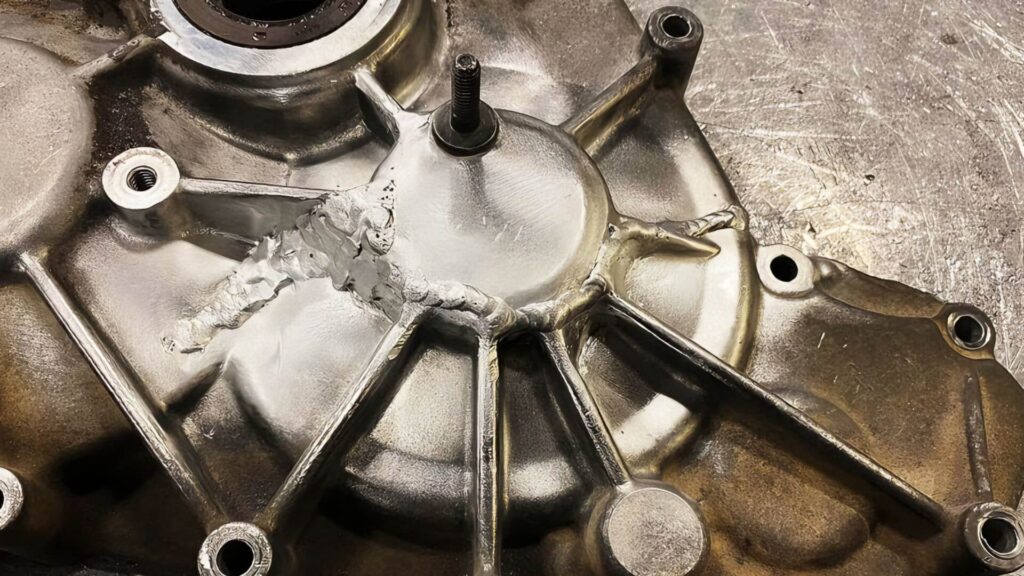
Aluminum melts lightning fast.
- Aluminum: 1,220°F (660°C).
- Steel: 2,500°F (1,370°C).
If you put an aluminum can in a campfire, it will vanish. Steel takes serious heat to melt.
Also, aluminum does not glow red before it melts. One second it is solid, the next it is a puddle on the floor. Be careful.
Steel vs. Iron and Titanium
This is a closer fight.
- Cast Iron: Actually melts sooner than steel (around 2,200°F). Because it has so much carbon, it acts like salty ice.
- Titanium: The winner. It melts at a scorching 3,034°F (1,668°C). This is why jet engines use titanium. Steel would turn into spaghetti in that kind of heat.
Steel vs. Lead and Copper
You can melt lead on your kitchen stove. Don’t, because the fumes are toxic and hazardous, but you could.
Lead melts at just 620°F. Copper is tougher (1,984°F), but still melts way before steel.
Metal Melting Cheat Sheet
Here is a quick reference table. The Melting Difficulty column shows you exactly what equipment is required
| Metal | Melting Point (°F) | Melting Point (°C) | Melting Difficulty | Quick Fact |
|---|---|---|---|---|
| Lead | 620°F | 327°C | 🔥 (Kitchen Stove) | Often used for bullets & fishing weights |
| Aluminum | 1,220°F | 660°C | 🔥🔥 (Campfire) | Melts suddenly without glowing red |
| Silver | 1,763°F | 961°C | 🔥🔥 (Propane Torch) | Common for jewelry casting |
| Copper | 1,984°F | 1,085°C | 🔥🔥🔥 (Small Furnace) | Needs a specialized crucible |
| Cast Iron | 2,200°F | 1,204°C | 🔥🔥🔥 (Coal Forge) | Used for engine blocks & cookware |
| Steel | 2,700°F | 1,482°C | 🔥🔥🔥🔥 (Industrial) | Requires electric arc or induction |
| Titanium | 3,034°F | 1,668°C | 🔥🔥🔥🔥🔥 (Vacuum Furnace) | Highest strength-to-weight ratio |
| Tungsten | 6,192°F | 3,422°C | 💀 (Extreme Lab) | Highest melting point of any metal |
Knowing these numbers is critical for safety. You don’t want to choose a metal that will turn into liquid halfway through the job.
But there is a catch. Just because steel is not melting does not mean it is safe. Often, the melting point is the wrong number to rely on
Why You Should Care About These Numbers
You probably aren’t a chemist. Why does it matter if steel melts at 2,500° or 2,800°F?
It matters because temperature dictates what you can build.
If you pick the wrong steel for a furnace, engine part, or fire pit, you are setting yourself up for failure. Here is why the melting point is not just trivia.
💡Real-World Fabrication Issues: The “Heat Affected Zone”
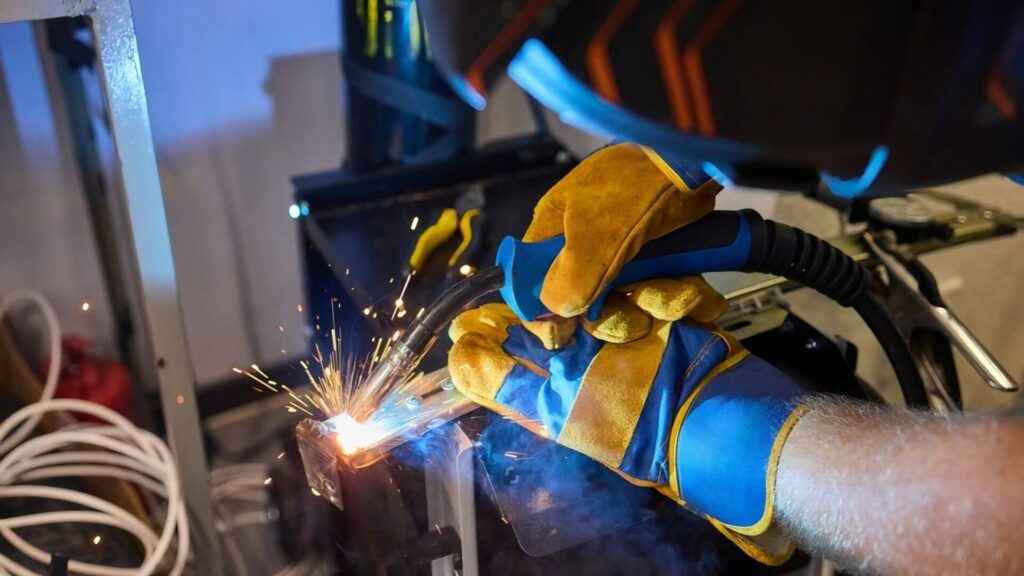
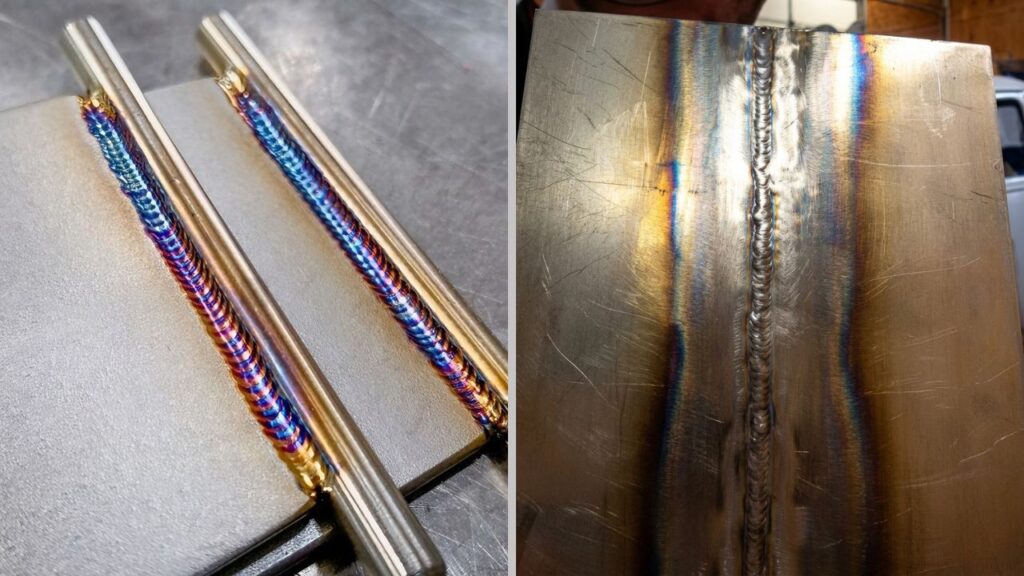
In our sheet metal processing, we rarely want to melt the entire piece. We only want to melt a tiny, controlled seam.When my team is TIG welding 304 Stainless Steel, we have to be incredibly careful. Because stainless steel has a lower thermal conductivity and a specific melting range, the heat doesn’t dissipate quickly. If the welder lingers too long, we don’t just risk melting a hole; we create a massive “Heat Affected Zone” (HAZ). This causes the sheet metal to warp and buckle.
We often see design files from clients who don’t account for this. They choose a material with a lower melting point but design it for high-heat welding. The result? A warped product that doesn’t fit together. Understanding the melting point helps us choose the right welding speed and cooling fixtures to keep the product within tolerance.
For Casting and Molding
Do you want to pour liquid steel into a mold? You need a furnace that can get hotter than the metal itself.
- Propane Forges: great for softening steel (blacksmithing).
- Charcoal Foundries: struggle to reach 2,800°F consistently.
- Electric Induction: the gold standard for melting steel.
If your furnace only reaches 2,600°F, you might successfully melt cast iron but fail to melt low-carbon steel. You will just end up with a hot, glowing lump.
Safety and Fire Resistance
Structural steel in buildings needs to withstand fire.
Standard house fires burn around 1,100°F. That is well below the melting point of steel (2,500°F+). So, steel beams won’t turn into liquid in a normal fire.
However, they don’t have to melt to fail.
This is the most critical misunderstanding people have about steel. Just because it isn’t dripping like candle wax doesn’t mean it’s still holding up the roof. Let’s talk about the danger zone before the melting point.
Melting vs. Failing: A Critical Warning
You see steel beams in a fire, and they look perfectly fine. They aren’t melting. They aren’t dripping.
But they are about to collapse.
Do not mistake the melting point for a safe operating temperature.
According to the American Institute of Steel Construction (AISC), steel loses its strength significant long before it turns into a liquid puddle.
Losing Strength Before Melting
Imagine a stick of butter on a hot day. It isn’t liquid yet, but if you poke it, your finger goes right through.
Steel does the same thing.
At room temperature, steel is incredibly rigid. But heat it up to 1,000°F (538°C), which is less than half its melting point, and it loses about 50% of its yield strength.
It doesn’t melt, but it loses its rigidity.
If that steel beam is holding up a heavy concrete floor, gravity wins. The beam sags. The floor collapses.
This is why steel structures are often coated in fireproofing spray. The goal isn’t to stop the steel from melting (fires rarely get hot enough for that). The goal is to keep the steel cool enough (below 1,000°F) so it stays stiff.
💡A Lesson from the Floor: The “Oven Effect”
I remember a project where a client wanted us to fabricate brackets for an industrial oven using standard Mild Steel. Their logic was: “The oven only gets to 1,000°F, and steel melts at 2,700°F, so it’s safe.”I had to stop production and correct them. Yes, the steel wouldn’t melt, but at 1,000°F, mild steel loses significant rigidity. The brackets would have eventually sagged under the weight of the racks inside. We switched them to a high-temp alloy specifically because we looked at the yield strength at temperature, not just the melting point.
This is a conversation we have constantly at ShincoFab. Just because it doesn’t melt doesn’t mean it works.
Structural Integrity in High Heat
You should know the failure point instead of just the melting point. This is crucial if you are building something like a fire pit or engine bracket.
- Mild Steel: Starts losing significant strength around 750°F.
- Stainless Steel: Holds its strength better, up to about 1,500°F.
- Inconel / Exotic Alloys: Can stay strong near 2,000°F.
So, if you are designing for high heat, ignore the melting point. Ask instead when the steel will lose its strength.
Especially if you are planning to heat and beat steel yourself. Let’s talk about the DIY reality next.
Can You Melt Steel at Home? (The DIY Reality)
If you have watched Forged in Fire, you have seen people hammering glowing red blades.
But can you actually melt steel into a puddle of liquid metal in your backyard?
The short answer: Probably not.
Most DIY setups struggle to get hot enough.
Propane Forges vs. Charcoal
A standard propane forge (like the ones hobbyists buy on Amazon) can reach about 2,300°F (1,260°C). That is incredibly hot.
But steel melts at 2,500°F+. You will get it glowing white-hot, but it won’t turn into soup.
Charcoal burns hotter, potentially reaching 2,700°F if you pump in enough air. Ancient blacksmiths used charcoal to smelt iron. But hitting that precise temperature consistently is tough.
You might end up with a semi-melted sponge of iron rather than a clean liquid pour.
Softening vs. Liquefying
There is a big difference between forging and casting.
- Forging: You heat steel until it is soft like clay (around 1,800°F – 2,200°F). You hammer it into shape. This is totally doable at home.
- Casting: You heat steel until it is liquid (above 2,600°F). Then you pour it into a mold. This requires an induction furnace or a specialized crucible that won’t melt before the steel does.
If you are a beginner, stick to forging (softening). Trying to liquefy steel at home is dangerous and requires expensive gear.
But how do you know if your steel is hot enough without a $500 thermometer? You use your eyes. Let me show you how.
Judging Temperature by Color (Without a Thermometer)
You don’t need a high-end thermometer to know if your steel is hot enough.
You just need to look at it.
As steel absorbs heat, its color changes predictably. Blacksmiths have used this incandescence to judge temperature for thousands of years.
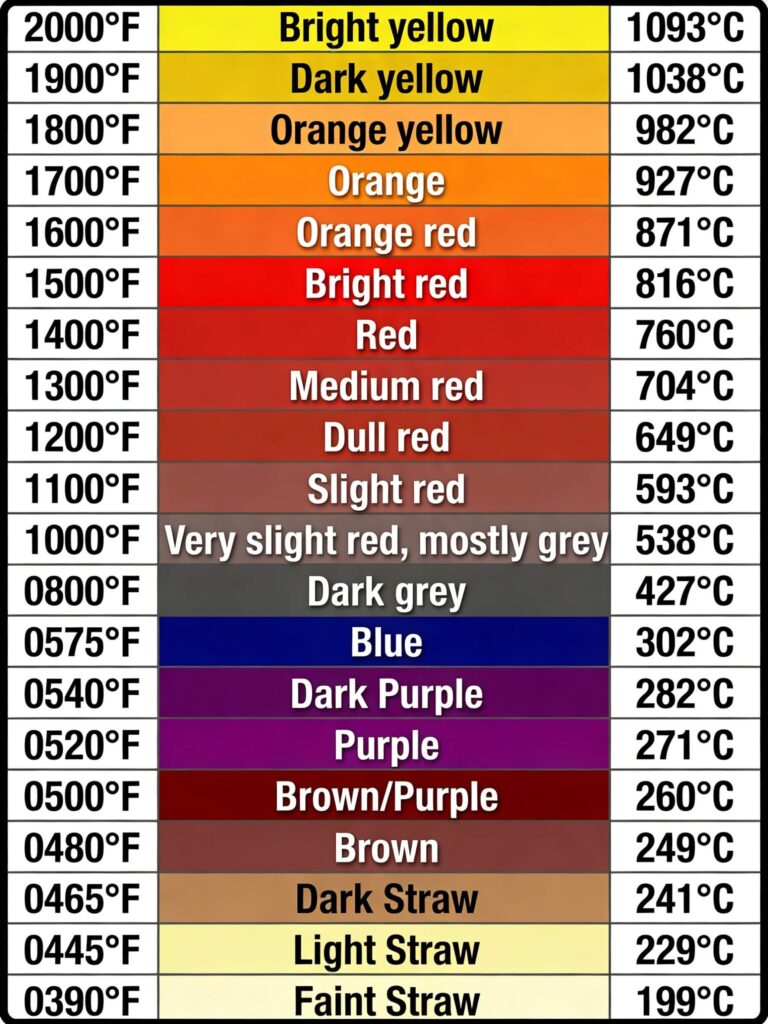
The Incandescence Scale
It starts Faint Red, then turns Orange, then Yellow, and finally White Hot.
If it’s glowing White, you are getting very close to the melting point.
But be careful: bright sunlight makes the glow look much cooler than it really is.
- In a dim shop, 1,000°F looks like a dull red.
- In the sun, 1,000°F looks like… dark grey metal. You won’t see the glow until you touch it (and get burned).
Always check your steel color in the shade!
Blacksmith’s Color Guide
Here is a quick reference table to help you judge temperature by eye.
| Steel Color | Approx. Temperature | State of Steel | What You Can Do |
|---|---|---|---|
| Dark Grey | < 1,000°F (530°C) | Stiff / Hard | Too cold. Do not bend or hammer. Risk of breaking. |
| Faint Red | 1,200°F – 1,500°F | Springy | Basic bending, but still tough. |
| Bright Orange | 1,600°F – 1,800°F | Plastic & Soft | Good Forging Heat. Safe for heavy shaping and bending. |
| Yellow | 1,900°F – 2,100°F | Very Soft (Like Clay) | Ideal Forging Range. Moves easily under the hammer. |
| White Hot | 2,200°F – 2,400°F | Sweating / Burning | Forge Welding. Surface is sticky. Watch carefully to avoid burning. |
| Sparking | > 2,500°F (1,370°C) | Burning / Melting | Destroyed. Steel shoots sparks (burning carbon). Stop and discard. |
If you overheat steel past white hot, it starts to burn. Literal sparks fly off like a sparkler. This ruins the metal
Wait, if you ruin it… can you fix it? What happens if you just melt the whole thing down? Let’s talk about recycling.
What Happens to Steel After It Melts? (Recyclability)
Here is the best part about steel.
No matter how many times you melt it… it comes back as good as new.
Steel is 100% recyclable and maintains its properties indefinitely.
You can melt down a rusty old car, turn it into a shiny new structural beam, then melt that beam down in 50 years to make a bicycle. The quality never drops.
Infinite Recycling
When steel melts, the atomic structure resets itself.
Any stress, cracks, or fatigue from its previous life are erased. The high heat allows the atoms to reorganize perfectly. The new metal is just as strong as the original nugget of iron ore.
Upcycling vs. Downcycling
This is very different from plastic or paper.
- Plastic (Downcycling): Every time you recycle a plastic bottle, the plastic gets weaker. Eventually, it can only become cheap filler or carpet.
- Steel (Upcycling): You can take scrap steel from a junkyard, melt it down, purify it, and turn it into high-grade aerospace alloy.
However, to do this on a massive scale, you need serious power. You can’t just use a propane torch. Let’s see how the professionals melt tons of steel every day.
How is Steel Melted Industrially?
So, how do you melt 100 tons of solid steel? You can’t just build a bigger bonfire.
Industrial foundries use electricity.
It is cleaner, hotter, and faster than burning coal. There are two main ways the big factories do it.
Electric Arc Furnaces
The Electric Arc Furnace (EAF) is the heavy hitter of the recycling world. It is used to melt down old cars, scrap beams, and shredded appliances.
It works exactly like a lightning bolt.
- Giant carbon rods are lowered into a massive pot of scrap metal.
- A massive electrical current shoots out of the rods.
- The electricity arcs (jumps) through the metal, heating it to over 3,000°F instantly.
It is loud. It is violent. But it is incredibly fast. An EAF can turn a pile of rusty junk into a pool of liquid steel in less than an hour.
Induction Furnaces
If the Electric Arc is a sledgehammer, the Induction Furnace is a scalpel.
It is used for smaller, high-quality batches (like stainless steel or specific alloys).
Here is the spooky part: The heater never touches the metal.
A copper coil wraps around the outside of the melting pot. It creates a powerful magnetic field that fluctuates rapidly. This invisible field grabs the iron atoms inside the pot and shakes them back and forth.
The friction from the shaking atoms creates heat from the inside out.
- No flame to contaminate the metal.
- No loud arcs.
- Just pure, melted steel.
Because it is so clean, induction is what you use when the chemical recipe has to be perfect.
Conclusion
The melting point of steel isn’t just one number. It ranges from 2,500°F to 2,800°F, depending on the precise soup of ingredients inside.
Whether you are a welder looking for a liquid puddle, a blacksmith watching for cherry-red colors, or an engineer designing a fire-safe structure, these numbers dictate what you can and cannot do.
Remember the golden rule driven home in this guide: Steel gets weak before it gets wet. By the time it actually melts, you have already lost your structural strength long ago.
Respecting the heat is the difference between a project that lasts forever and one that warps or fails.
That is exactly how we approach every project at ShincoFab. We understand how different alloys react to high temperatures during cutting and welding, ensuring that the final sheet metal product is strong, precise, and built to last.
So, check your alloy grade, watch your temperatures, and stay safe.