
Custom IP-Rated Electrical Enclosures
Precision fabrication for NEMA 4X & IP66 compliance. Featuring continuous TIG welding and automated polyurethane gasketing for superior sealing integrity.
An IP Rating is Only as Good as the Fabrication Tolerance Behind It
You can specify NEMA 4X or IP66 on your blueprints, but paper certifications do not stop water. Only precision does.
At ShincoFab, we understand the harsh reality of custom electrical enclosure fabrication: a supposedly rated unit fails instantly if the door flange is bent just 1mm out of tolerance.
When fabrication quality varies, the seal is compromised. And when the seal fails in a critical environment, the consequences are expensive and dangerous:
- Conductive Dust Ingress: Leading to arc flashes and potential dust explosions in ATEX zones.
- Moisture Intrusion: Causing short circuits, PLC failures, and unplanned production downtime.
- Salt Spray Corrosion: Eating away at micro fractures in the coating and destroying the cabinet integrity from the outside in.
While most shops only worry about bending metal, ShincoFab is obsessed with protecting your electronics through industry-leading precision.

How ShincoFab Engineer an Impenetrable Shield
True protection goes beyond the surface. From precision unibody welding to robotic sealing, every detail of our fabrication process is designed to eliminate weak points and keep harsh environments strictly on the outside.
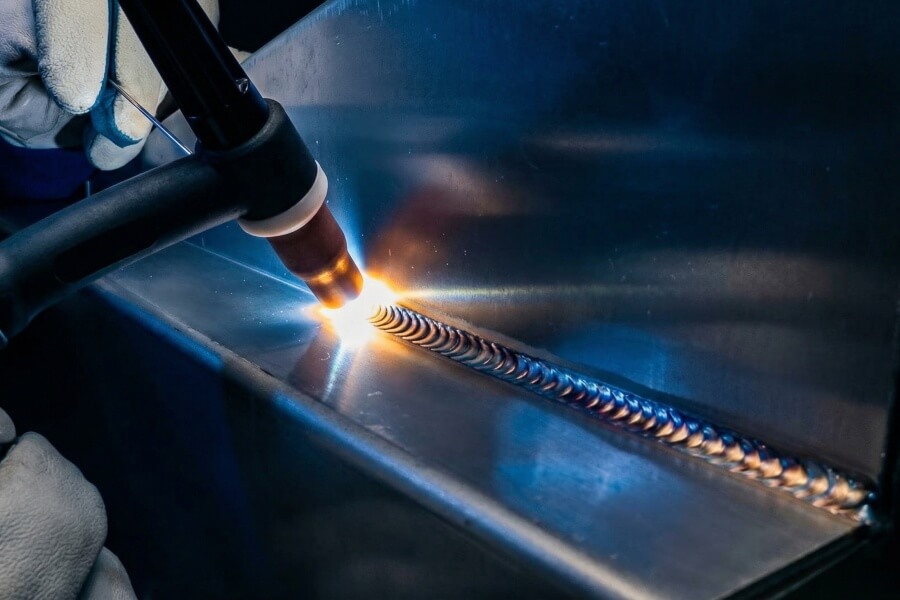
Continuous TIG Welding (No Stitching)
Standard stitch welding leaves microscopic gaps masked by paint using body filler. We don’t hide defects, we eliminate them. We utilize continuous TIG welding on all corner seams, ground smooth for a flawless finish. This creates a monolithic unibody structure where moisture simply has no path to enter.

Robotically Applied Polyurethane
Manual strip gaskets create joints that inevitably leak water. We utilize an automated Form In Place (FIP) polyurethane foam system. The robot applies a continuous liquid stream that cures into a seamless seal with superior compression memory. This ensures your IP rated enclosure maintains its integrity even after thousands of door cycles.

Leak-Proof Hardware Integration
Every hole cut for a latch or hinge is a potential failure point. We mitigate this risk by using bonded sealing washers and strict tolerance control on all cutouts. We utilize blind-rivet nuts (rivnuts) and stud welding for internal mounting, ensuring the external skin remains unbreached wherever possible.
Verified Protection Proven Before You Install
Don’t rely on assumptions. Rely on data. We validate our fabrication integrity against IEC and NEMA standards to ensure zero field failures.
The Protection Standard Guide (Technician’s Cheat Sheet)
Select the exact level of ingress protection your environment demands:
| IP Rating | NEMA Equivalent | Specific Hazard Protection | Typical Environment |
|---|---|---|---|
| IP54 | NEMA 12 |
Limited Dust & Splashing Water. Protects against settling dust and water spray from any direction. | Indoor manufacturing, assembly lines, non-washdown areas. |
| IP65 | NEMA 4 |
Low-Pressure Water Jets. Withstands 12.5mm nozzle water jets (30kPa) from any angle. | Outdoor telecom, light washdown zones, humid processing plants. |
| IP66 | NEMA 4X |
High-Pressure Water Jets. Withstands powerful 12.5mm nozzle jets (100kPa) at 100 liters/minute. | Heavy washdown (Food & Bev), Marine/Offshore, Chemical plants. |
| IP67 | NEMA 6 |
Temporary Submersion. Complete seal against immersion up to 1m depth for 30 minutes. | Flood-prone areas, sub-surface utility vaults. |
In-House Verification Protocol
We do not verify protection with a garden hose. We test strictly against the standard.
Hydrostatic & Ingress Testing (IEC 60529)
Every new custom enclosure design undergoes validation in our testing facility. We utilize calibrated spray nozzles strictly adhering to IEC 60529 flow rate and pressure specifications to simulate worst-case scenarios. If a drop of moisture is detected on the blotting paper inside, the design is rejected.
Dust Chamber Validation
For critical dustproof electrical applications, we employ talcum powder circulation chambers under vacuum pressure to verify the integrity of the continuous-weld seams.
Certification Capabilities
Need a stamped rating? As a UL-listed fabrication partner, we can label your enclosures for:
- UL 508A Type 4/4X Industrial Control Panels
- CSA C22.2 Compliance
Match the Metal to Your Environment
Specifying 316L for a dry server room burns your budget. Specifying Carbon Steel for an offshore rig guarantees failure. We help you select the precise alloy for your application’s corrosion risk and thermal needs.

Carbon Steel (CRS) + Polyester Powder Coat
- Best For: Indoor Industrial, Dry Environments, General NEMA 1/12/4 Applications.
- The Technical Edge: We don’t rely on thin, aesthetic paint jobs. Our automated powder coating line applies a structural polyester finish to 80-120 microns. This thickness provides superior scratch resistance and acts as a robust barrier against humidity, ensuring NEMA 4 ratings even on cost-effective steel.
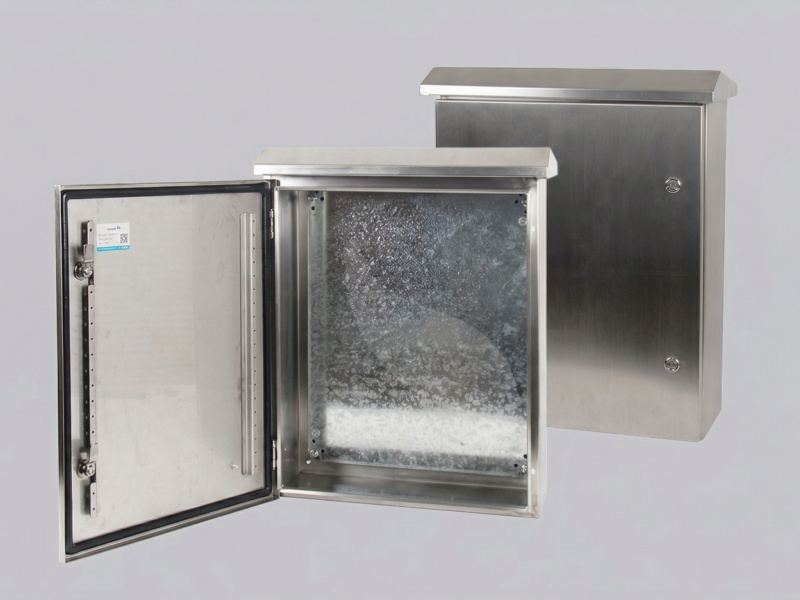
Stainless Steel 304 (1.4301)
- Best For: Food & Beverage, Pharmaceutical Washdown, Moderate Moisture.
- The Why: The industry standard for hygiene. Its high chromium content forms a passive oxide layer that self-repairs when scratched. Ideal for daily high-pressure washdowns where caustic chemical exposure is low.
- Note: Avoid in high-salinity zones.

Stainless Steel 316/316L (1.4404)
- Best For: Marine (Offshore), Chemical Plants, Wastewater Treatment (High Chlorides).
- The Critical Difference: If your enclosure faces salt spray or chlorides, 304 will succumb to pitting corrosion. You must upgrade to 316L. The addition of Molybdenum (Mo) drastically significantly increases resistance to chloride-induced pitting and crevice corrosion. We recommend the “L” (Low Carbon) grade to prevent intergranular corrosion at weld zones.
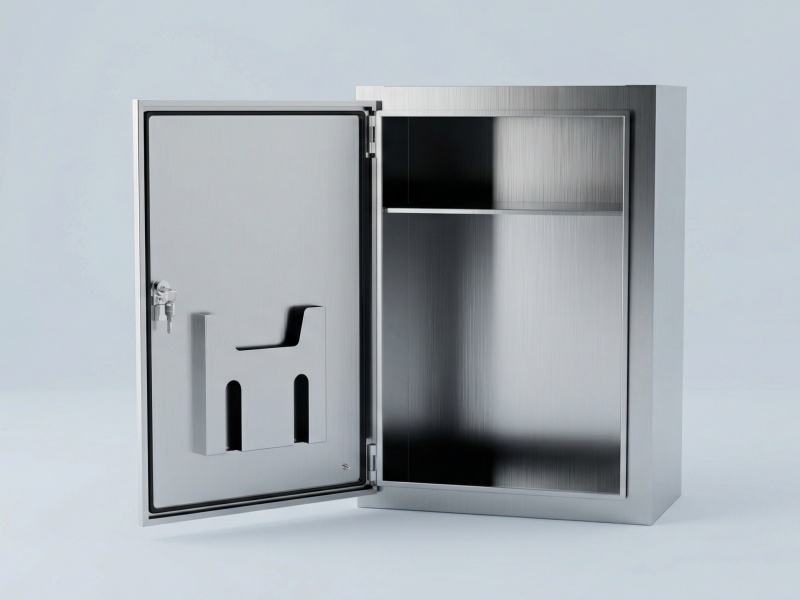
Aluminum (5052-H32 / 6061-T6)
- Best For: Outdoor Telecom, Solar Inverters, Traffic Control Cabinets.
- The Thermal Advantage: When internal electronics generate high heat loads, steel acts as an insulator (trapping heat). Aluminum offers thermal conductivity ~4x higher than steel, acting as a natural heat sink to dissipate internal temperatures. Its natural oxide layer also provides excellent corrosion resistance without heavy plating.
Built Around Your Components, Not a Catalog
Off-the-shelf enclosures force compromises. Our custom fabrication eliminates on-site drilling, reduces assembly time, and guarantees NEMA integrity for every modification.
Thermal Management Integration
- The Problem: High-performance electronics generate heat, but standard ventilation kills IP ratings.
- Our Solution: We precision-cut apertures for filtered fans, air-to-air heat exchangers, and closed-loop A/C units. Critically, we design the mounting interface to ensure the installed cooling device maintains the NEMA 4/4X seal of the entire assembly.

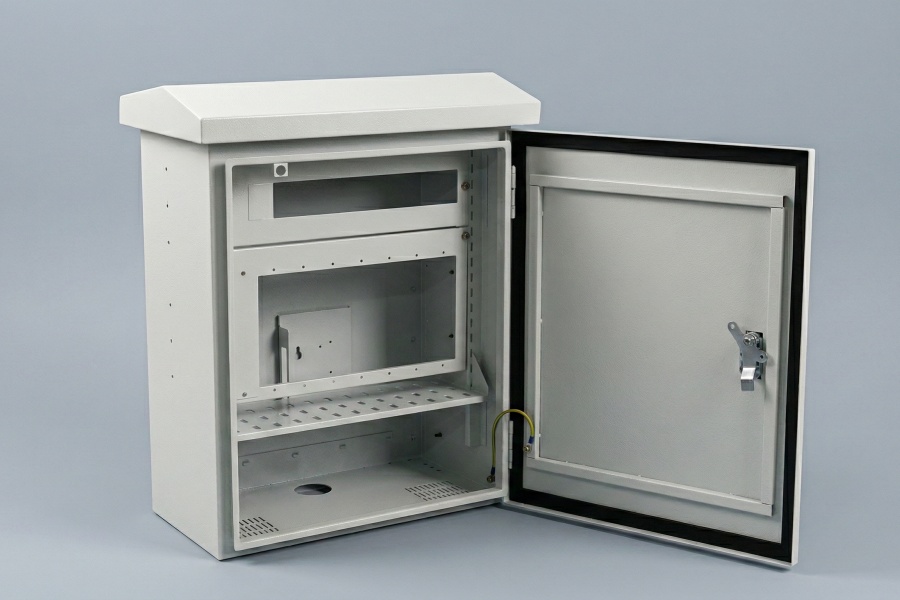
Strategic Cable Entry & Gland Plates
- The Problem: Field-drilling holes creates metal shavings that cause short circuits and exposes raw steel to rust.
- Our Solution: Send us your wiring diagram. We laser cut custom knockout patterns and install removable gasketed gland plates on the top, bottom or side. Your team simply inserts the cable glands to eliminate drilling, filing and debris.
Turnkey Internal Configuration
- The Problem: Wasting expensive technician hours installing basic hardware.
- Our Solution: Your enclosures arrive ready for wiring. We pre-install:
- DIN Rails & Wire Ducting: Cut to length and mounted to your layout.
- Backplanes: Galvanized or white powder-coated, pre-tapped for your PLC/VFD.
- Swing-Out Panels: For HMI mounting or dead-front safety shields.


ASTM Compliant Finishes
- The Problem: Generic outdoor rated paint often chalks and fades within 12 months.
- Our Solution: We utilize Super Durable Polyester Powder Coating formulated without TGIC for superior UV stability in outdoor deployments.
- Verified Standard: Tested for chalking and color retention compliance under ASTM D7803.
- Corrosion Barrier: A five stage pretreatment wash ensures adhesion to withstand over 1,000 hours of salt spray.
Supply Chain Certainty with Consistent Quality and On-Schedule Delivery
We understand that a late enclosure means a stalled assembly line. Our production planning aligns directly with your project milestones.
Transparent Lead Times
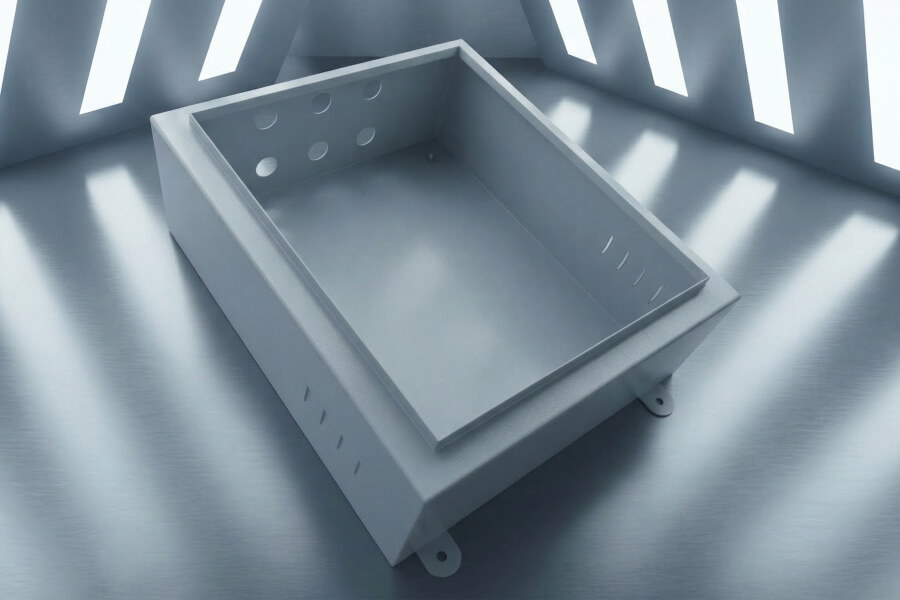
Rapid Prototyping (NPI): 5-7 Business Days.
Receive a fully functional, production-grade sample for fit-check and thermal testing before committing to tooling.
Volume Production: 3-4 Weeks Standard.
Once the design is frozen, our ERP-driven scheduling ensures your batch hits the shipping dock on the committed date. Expedited services available for critical path emergencies.
Scaling from High-Mix to High-Volume
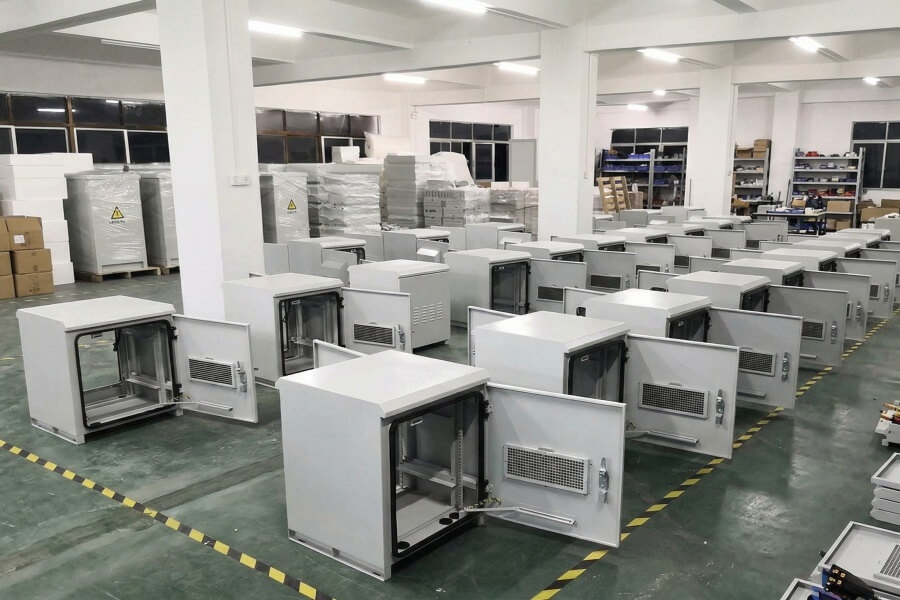
- Flexibility: Whether you need 1 single unit for a custom pilot project or 5,000+ units staggered over a blanket order, our facility adapts.
- Equipment: We utilize automated Trumpf laser centers for speed and consistency, ensuring the 5,000th unit is identical to the 1st.

Compliance & Risk Management
Traceability: ISO 9001:2015 Certified.
Every batch is fully traceable from raw material heat numbers to the final inspection report.
Global Standards:
- UL / cUL: Listed fabrication partner capabilities (UL 508A).
- CE: Declaration of Conformity available for EU exports.
- RoHS / REACH: Material compliance documentation provided for all gaskets and coatings.
Have a Design in Hand? Request a Quote for IP Enclosure Fabrication by Tomorrow
Stop waiting days for a simple estimate. Upload your DXF or STEP files now and our engineering team will validate your IP requirements and return a firm quote within 24 hours.
Frequently Asked Questions
Before you finalize your spec, review these common engineering challenges regarding IP ratings and material costs.
Can I integrate a viewing window without compromising the IP66/NEMA 4X rating?
Yes, but only if the interface is engineered correctly. We do not simply adhere plexiglass to the surface.
We utilize UV-stabilized Polycarbonate (for impact resistance) or Tempered Glass (for chemical resistance). The window is mechanically secured using a dedicated stud-mount bezel and sealed with our automated Form-In-Place (FIP) polyurethane gasket. This ensures the window assembly has the same ingress protection as the steel body itself.
What is the real cost difference between NEMA 4 and NEMA 4X?
The price difference is driven almost entirely by raw material costs.
- NEMA 4 (Indoor/Outdoor protection): Uses Carbon Steel with a powder coat. It is cost-effective and durable but relies on the coating for protection.
- NEMA 4X (Corrosion protection): Requires Stainless Steel (304 or 316).
Rule of thumb: Expect the raw material cost for Stainless 304 to be roughly 2.5x to 3x higher than Carbon Steel. However, for washdown or corrosive environments, the Lifecycle Cost (LCC) of NEMA 4X is significantly lower because it eliminates repainting and replacement due to rust.
If the enclosure is perfectly sealed, how do you prevent internal condensation?
A perfect seal keeps water out, but it can also trap atmospheric moisture in, creating a greenhouse effect when temperatures fluctuate (Dew Point issues).
To combat this, we recommend two specific modifications:
- Breathable Membrane Vents: Passively equalize pressure while blocking water molecules (IP68 rated).
- Anti-Condensation Heaters: For outdoor cabinets with wide temperature swings, a small DIN-rail heater keeps the internal temperature above the dew point.
Turn Your CAD Files into Certified Hardware
Speak directly with a fabrication expert regarding material selection and thermal management. We analyze your environment to recommend the most cost effective path to NEMA compliance.
